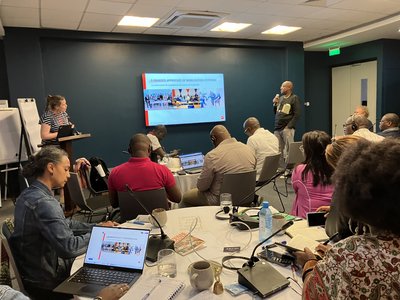
Closing of the UFI Week 2024
The closing session of the Semaine des Pépinières Urbaines featured two researchers: Ninon Ndongo Fandre and Ayanda Roji. Their talks looked back at the evolution of UFI, but also raised crucial issues for the future of the initiatives.
Ninon Ndongo Fandre is a master's student at the University of Geneva, writing her dissertation on urban nurseries.
Ayanda Roji is coordinator of the Center on African public spaces (CAPS) network, a platform for the exchange of knowledge on public spaces between African urban professionals, public space defenders, academics, activists and community groups, created in 2018 following the Africities summit.
Different perspectives and future challenges
"Public spaces and other social facilities are essential not only because they build buildings, but also because they help to strengthen communities (in the sense of cohesion and social organisations)." Ayanda Roji, CAPS
- Ninon Ndongo Fandre highlighted a major shift in the nature of the infrastructures created by the UFI. While they were initially seen as temporary, their permanent nature now calls into question their relationship with major urban projects. She also stressed the need to preserve the transformative identity of UFI when it comes to land issues, while praising their creativity in finding solutions.
- Ayanda Roji recalled the importance of public spaces as pillars of social cohesion and urban resilience, which are often underestimated by political decision-makers. She called for a stronger commitment from institutions, notably AFD, to defend and promote these spaces, which are genuine vectors for inclusion and social justice.
"Urban Fabric Initiative is a movement, a revolution. I will go home feeling like a revolutionary nurseryman." Hamid Gbawuru Marah, Mercy Corps, Monrovia
Between innovation, autonomy and complementarity with major projects
The debate that followed the presentations by the two researchers highlighted the richness of the practices of the UFI, particularly in terms of citizen participation, shared management of facilities, and their ability to experiment with innovative solutions despite constraints. The speakers also emphasised the complementarity of the UFI with major urban projects, while defending the autonomy they need to guarantee their potential for innovation.
Finally, the closing session revealed strong expectations in terms of sharing experiences, disseminating tools and training, as well as a growing demand for expertise and practical guides on the management of public spaces.
Laboratories for urban transformation
Several key characteristics of UFI emerged from the discussion.
- Their expertise in citizen participation, through specific approaches and tools, deserves to be more widely disseminated via networks such as CAPS or training courses for local elected representatives and technicians.
- In terms of infrastructure, UFIs are experimenting with management, upkeep and maintenance methods for new public facilities, be they sporting, cultural or other; they rely on shared governance between civil society and public players, and support social and solidarity-based entrepreneurship.
- UFIs are also involved in revitalising neglected urban areas, strengthening the capacity of public authorities to take positive action.
- Their projects are characterised by a desire to transform urban practices and by their complementarity with major urban projects, by testing solutions that could be integrated on a larger scale. Nevertheless, their autonomy is crucial to preserving a space for experimentation, allowing for risk-taking and error, which are essential to innovation.
- Finally, their frugal, creative and flexible nature enables them to find solutions adapted to highly constrained contexts, but also makes them more fragile.