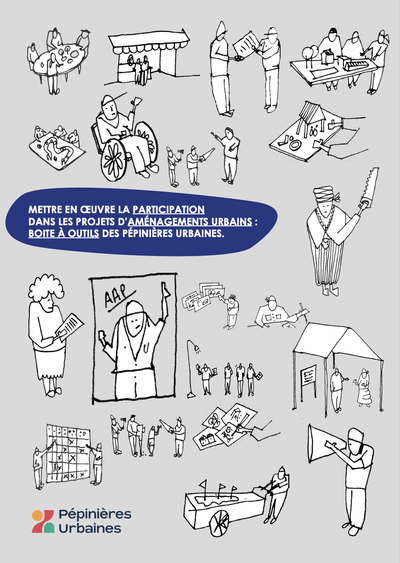
Discover the UFI Toolkit!
The UFI Programme (PAPU) is pleased to present its technical handbook entitled ‘Implementing participation in urban development projects: a toolkit from urban fabric initiatives’.
This compilation, the result of eight years of field trials and participatory initiatives carried out within various urban nurseries, brings together lessons learnt, methods and tools that have been tried and tested in a variety of contexts.
The aim of this guide is to share the practices developed and tested in real-world situations by UFI operators and practitioners in the field, in order to support the implementation of participatory approaches tailored to the challenges of urban planning.
Why a Toolkit?
The involvement of citizens, residents and service users is a key driver in designing projects that are more relevant, more inclusive and better embraced by the communities and residents concerned. The UFI Toolkit has been designed to facilitate, structure and strengthen this involvement throughout the life cycle of an urban project. It offers practical methodological guidelines that enable the balancing of time, budget and human resource constraints with the objectives of inclusion, dialogue and social impact.
More than just a manual, it is a decision-making tool that supports teams in their deliberations and methodological choices at every stage of a project.
Who is it aimed at?
This sharing of expertise is aimed at planning professionals, project owners and urban planning practitioners wishing to incorporate collaborative and inclusive approaches into their projects and areas of operation.
On the one hand, it serves as a resource for future incubator operators who will be rolling out new initiatives on the ground and wish to draw on lessons learnt from previous experiences.
Furthermore, it is aimed at all professionals working in the fields of urban planning, spatial planning, public participation and territorial development who wish to draw inspiration from the participatory approach and methodology developed by Pépinières urbaines/UFI.
What’s in the toolkit?
The collection brings together 16 technical fact sheets organised according to the four main stages that make up the life cycle of an urban project.
Diagnosing to understand the context
This first stage aims to gain a better understanding of the area, its stakeholders and how it is used.
The tools on offer include:
- mapping local stakeholders;
- observation grids;
- exploratory walks;
- qualitative interviews.
These methods enable us to gain a detailed understanding of local issues before moving on to the design phase.
Designing in collaboration with stakeholders
The second phase is dedicated to developing projects in collaboration with local residents and stakeholders.
The factsheets include, in particular:
- Transitional or mobile participation devices;
- drawing workshops;
- programming workshops;
- serious games;
- site model.
These tools encourage people to express their needs, exchange views and come up with shared solutions.
Building by drawing on local skills
Participation does not end with the design stage. It can also take place during the implementation of projects.
In particular, the toolkit documents:
- measures to build capacity of craftspeople;
- constructions training sites;
- labour-intensive construction (HIMO/LIC).
These approaches help to strengthen the local roots of projects whilst making the most of existing expertise.
Managing and maintaining the facilities over time
Finally, the last stage concerns the governance and long-term sustainability of the developed areas.
The factsheets cover, in particular:
- calls for proposals for activation projects;
- shared management agreements;
- responsibility matrices;
- usage assessments.
The aim is to support stakeholders in implementing sustainable management practices tailored to local circumstances.
Feedback from several African cities
Each fact sheet is enriched by the lessons learnt from experiments carried out in several towns where the UFI Programme is active.
Users will find practical information on:
- the level of financial investment required;
- the time required for implementation;
- the human resources deployed;
- the advantages and limitations observed in practice.
These analyses are based, in particular, on studies carried out in Abidjan, Antananarivo, Dakar, Kigali, Nairobi and Ouagadougou.
A tool that can be adapted to any context
The toolkit is not intended to provide one-size-fits-all solutions.
As the handbook points out, each region has its own dynamics, constraints and opportunities. The tools presented should therefore be regarded as methodological guidelines to be scrutinised, reinterpreted and adapted to local circumstances. Participation is, above all, a process that is shaped through engagement with the stakeholders and the contexts in which it takes place.
Where can you find the guide?
In order to cater for a variety of uses and to promote the widespread dissemination of knowledge, the toolkit is available in two complementary formats.
- Each resource sheet in the Toolkit has its own page within the ‘Toolkit’ tab on the UFI website.
This structure allows for quick and flexible access to content, tailored to users’ needs. The sheets can be accessed individually, making it easier to find tools suited to a specific situation or stage of a project. - The publication is also available as a printable PDF booklet online. Each double-page spread features: on the left, a general overview of the tool, its objectives, preparation requirements and facilitation methods; on the right, a practical example of its implementation drawn from the experiences of the UFI.