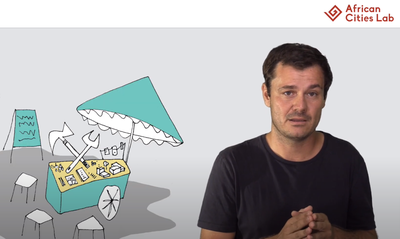
Participatory diagnosis by Florent Chiappero and Cheikh Sow
In this video, Florent Chiappero and Cheikh Sow explain the concepts of "participatory", "frugal" and "transitional" urbanism. They also detail why it is important to involve and co-produce public spaces with the habitant⋅es.
Over the last ten years or so, urban planning practices have been renewing the ways in which public spaces are approached: "tactical", "proximity", "neighbourhood", "frugal", "temporary" or "placemaking" urban planning. These approaches invest or reinvest neglected spaces, sometimes at minimal financial cost. Their aim is to restore social value and meaning to these spaces and their uses. While the results of these interventions may be temporary, they nonetheless have an impact on the residents⋅e⋅s and users⋅es, stimulating their imagination and encouraging them to take ownership of these spaces.
Florent Chiappero is a qualified architect, place-maker and urban planning researcher. He is one of the co-founders of the architects' collective Collectif Etc, with whom he has worked on public space projects in France and Europe for almost 10 years. He now devotes his time to Studio Baïnem, and for the last two years has been working in Senegal on the Pépinière Urbaine in Dakar.
Cheikh Sow is in charge of communications and audiovisual productions at the NGO urbaSen. He also works on community mobilisation projects. At the Pépinière Urbaine in Dakar, he helped design tools for dialogue and diagnosis.
MOOC Collective urban factory - Supporting multi-stakeholder collaborations, inspiring new ways of making cities The "Collective Urban Design" e-learning course explores the potential and challenges of urban co-production. Using concrete examples, the MOOC looks at the possible relationships between public and private action, formal and informal, at every decision-making stage, from the design to the management of the urban environment. Aiming to explore new collaborative ways of doing things, it is made up of five modules, aimed at all urban practitioners and technicians wishing to open up to new methods and approaches to social and institutional intermediation.